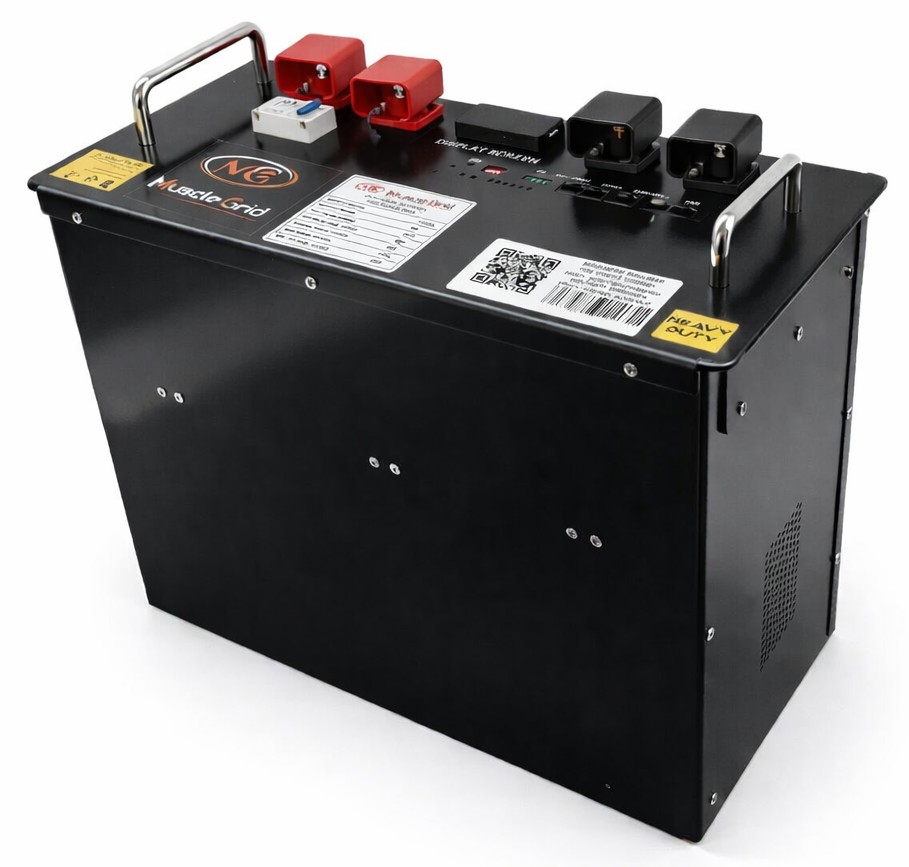
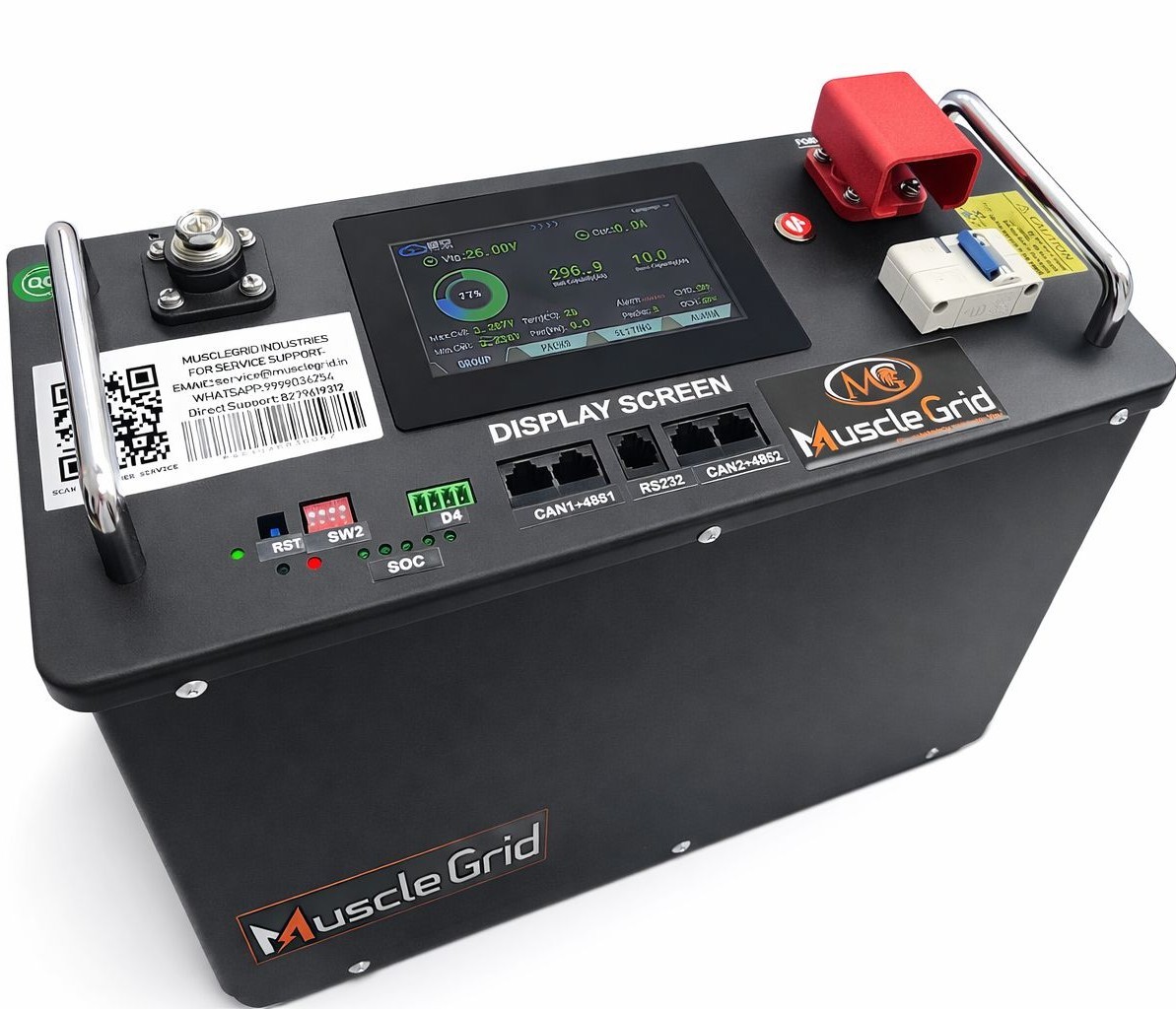
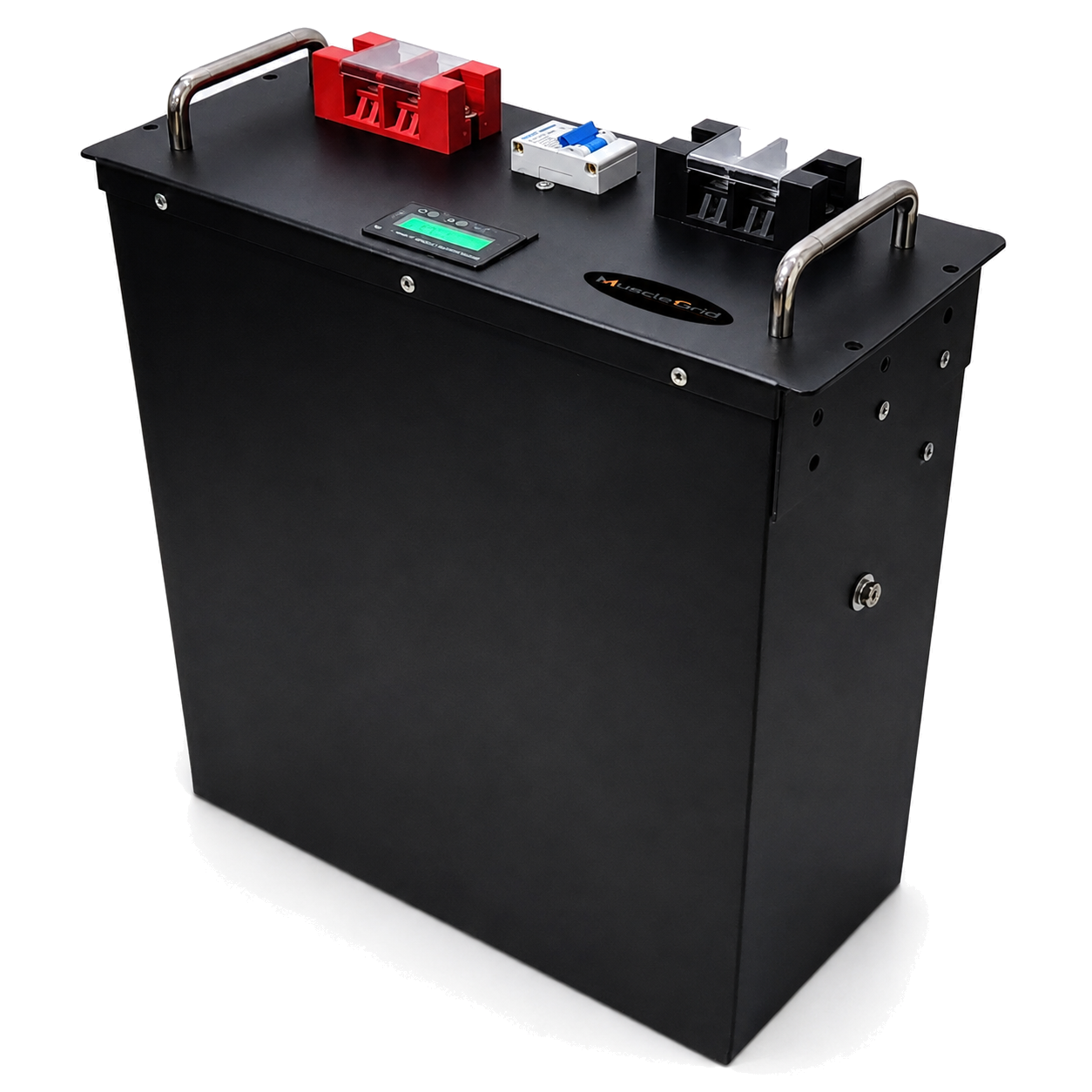
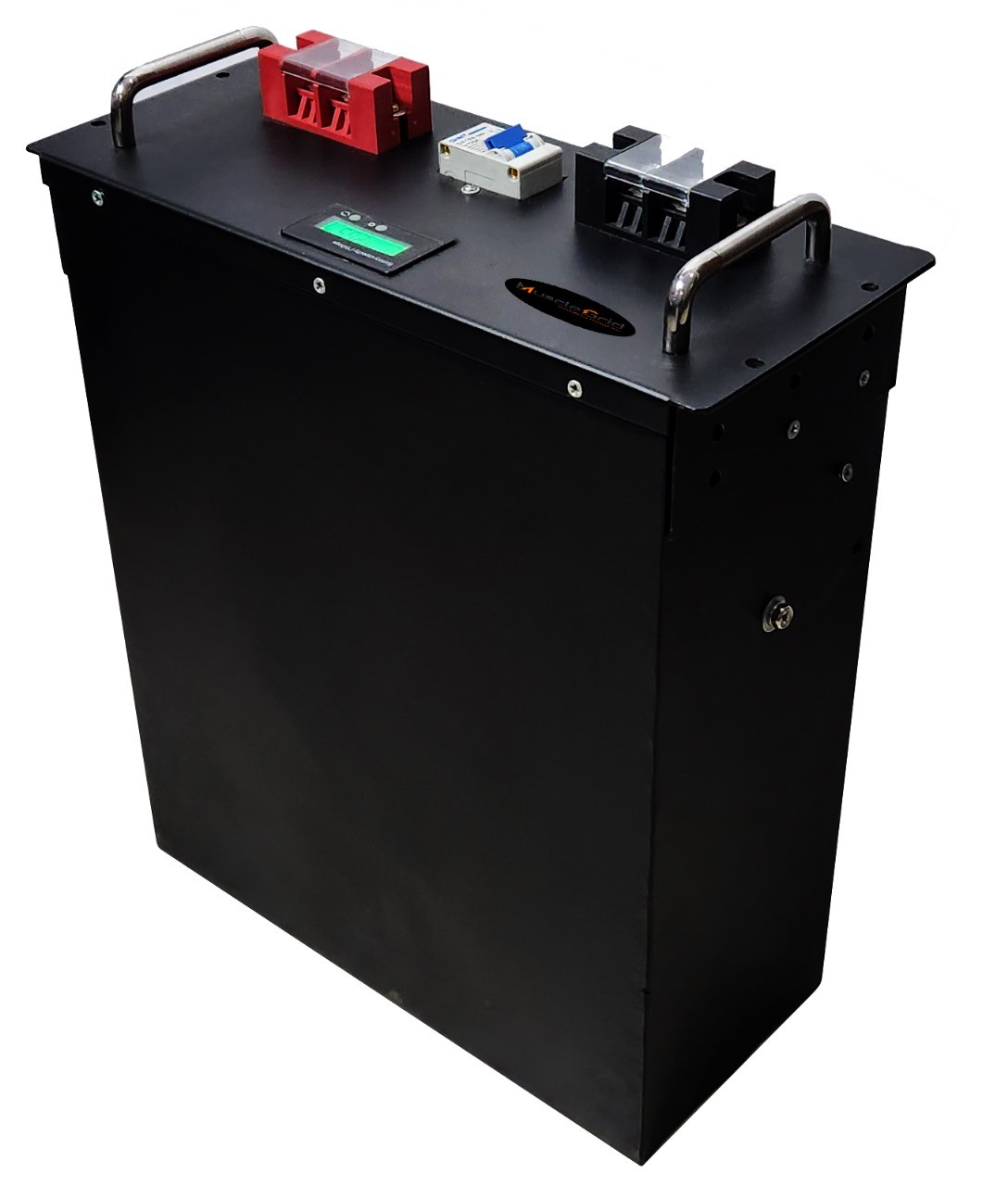
Lithium battery price in India
Lithium battery price is driven by stored energy, not by the label on the case. Multiply voltage by amp-hours and you get watt-hours — a 12V 100Ah pack holds 1.2 kWh, while a 48V 120Ah pack holds about 5.8 kWh. That is why the second costs several times the first despite both being “100-odd amp-hours”. When you compare quotes, compare rupees per kWh.
| System voltage | Capacities | Models | Starting price | Typically used for |
|---|
| 12V | 100Ah | 1 | ₹15,810 | small inverters, CCTV, fishing and portable packs |
| 24V / 25.6V | 100–255Ah | 4 | ₹40,191 | 2–3 kW home inverters and shop backup |
| 48V / 51.2V | 100–400Ah | 12 | ₹58,210 | 5 kW and larger hybrid solar systems |
Prices are current MuscleGrid store prices and move with the catalogue.
Which voltage should you buy?
The battery bank has to match the DC input your inverter was built for. A 24V inverter needs a 24V (25.6V) bank; a 48V inverter needs a 48V (51.2V) bank. This is not a preference — the wrong voltage will not run the inverter and can damage it. If you already own the inverter, the model number decides the battery.
Sizing the capacity
Work from the load you actually need to carry, not the biggest number you can afford. Add up the watts you want running during a cut, multiply by the hours you want them to run, then divide by the pack's kWh and allow around 80–90% usable depth of discharge. A 700W load for 4 hours is 2.8 kWh, which a 24V 120Ah pack (3.07 kWh) will carry comfortably.
LiFePO4 against lead-acid and tubular
Lithium iron phosphate costs more on day one and less over the life of the battery. You can use 80–90% of the rated capacity against roughly half of a tubular battery's, so a 100Ah lithium pack does the work of a much larger lead-acid one. It needs no water top-ups, no ventilated battery box, and holds a far flatter voltage as it discharges, so appliances see steadier power near the end of a backup.
- Cycle life — 3,000 to 6,000 cycles depending on series, against a few hundred for typical tubular.
- Usable capacity — 80–90% depth of discharge without harming the cells.
- Weight — roughly a third of the equivalent lead-acid bank, which matters on walls and in lofts.
- Maintenance — sealed, no distilled water, no acid fumes.
- Built-in BMS — protects against overcharge, deep discharge, short circuit and temperature extremes.
Buying from MuscleGrid
We build these packs ourselves rather than rebadging them, which is why the warranty is handled by our own service team and not passed to a third party. Every lithium battery carries a five-year warranty against manufacturing defects and cell or BMS failure, and you get a GST invoice on every order. If you are matching a battery to an existing inverter and want it checked first, send us the inverter model and we will confirm the pairing before you buy.
How long does a LiFePO4 battery actually last?
A lithium iron phosphate cell is rated in cycles, not years. One cycle is a full charge and discharge. Our packs use A-grade LiFePO4 cells rated for several thousand cycles at normal depth of discharge — if you cycle a pack once a day, that is well over a decade of daily use before capacity drops to the point where you would consider replacing it.
A tubular lead-acid battery in the same duty typically gives you 3 to 5 years, and it loses capacity steadily the whole way. That is the number that matters when you compare prices: a lithium pack costs more once, and a tubular bank costs less three or four times.
Two things shorten lithium life more than anything else — charging it from a charger that does not know it is lithium, and running it flat repeatedly. Neither is expensive to avoid.
What size battery do you need?
Work in kilowatt-hours, not amp-hours, because amp-hours only mean something once you fix the voltage. The arithmetic is kWh = volts × amp-hours ÷ 1000. A 48V 100Ah pack is 4.8 kWh; a 25.6V 100Ah pack is 2.6 kWh. The same “100Ah” is nearly twice the energy at the higher voltage, which is why comparing batteries on Ah alone is misleading.
LiFePO4 is safely usable to roughly 90% depth of discharge, so plan on about 90% of the rated energy being genuinely available, less 5–10% for inverter losses.
| What you want to back up | Running load | For 4 hours | For 8 hours |
|---|
| Fans, lights, TV, router | 300 – 600 W | 2.6 kWh | 5.1 kWh |
| The above + fridge | 800 – 1,200 W | 5.1 kWh | 10.2 kWh |
| Whole 2BHK, no air conditioning | 1,500 – 2,500 W | 10.2 kWh | 20.5 kWh |
| Home + one 1.5-ton AC | 2,800 – 4,000 W | 16.1 kWh | — |
| Shop or small clinic | 3,000 – 5,000 W | 20.5 kWh | — |
Round up rather than down. A pack that is never taken below half its capacity lasts considerably longer than one worked to the floor every night.
Will it work with the inverter you already have?
The voltages must match. A 48V pack needs a 48V inverter. 51.2V is the same thing — it is the nominal voltage of a 16-cell LiFePO4 stack, and a 48V inverter runs it correctly.
What matters beyond that is the charging profile. Lithium wants a constant-current then constant-voltage charge with a hard cut-off; a charger set for lead-acid will keep pushing a float voltage the pack does not want. Most modern hybrid inverters have a lithium battery type in the settings menu — selecting it is usually the whole job. Older transformer-based inverters often cannot, and that is the case where a lithium pack genuinely does not suit the existing hardware.
If you are unsure, send us the inverter model. We would rather tell you it will not work than sell you a battery that disappoints.
What the BMS does, and why it is the part that matters
The Battery Management System is the electronics inside the pack. It stops any cell being over-charged or over-discharged, cuts the pack off on over-current or short circuit, and shuts down outside safe temperature. Without it a lithium pack is not safe; with a poor one it is not reliable.
Our packs use a JK Smart BMS with an active balancer. The distinction matters: a passive balancer bleeds charge off the strongest cell as heat, while an active balancer moves charge from the strongest cell into the weakest. In a pack of 15 or 16 cells that difference decides whether the pack ages evenly or is eventually limited by one tired cell. The larger packs also carry Bluetooth and CAN/RS485, so the inverter and your phone can both read cell-level voltages, temperature and state of charge.
Is LiFePO4 safe?
Lithium iron phosphate is the safest of the common lithium chemistries. It is not the same chemistry as the NMC cells in phones, laptops and most electric scooters — LiFePO4 has a far higher thermal runaway threshold and does not carry the same fire risk. That is precisely why it is the chemistry used for home and solar storage rather than for anything where energy density matters more than safety.
Mount the pack somewhere ventilated and dry, keep the terminals torqued properly, and use cable of the right gauge for the current. Loose terminals and undersized cable cause more field problems than cells ever do.
Connecting more than one pack
In parallel — same voltage, more capacity. Two 48V 100Ah packs in parallel give 48V 200Ah. Use packs of the same voltage, the same capacity and similar age. Do not parallel a new pack with one that has been in service for two years; the older pack drags the newer one down.
In series — higher voltage, same capacity. This is where care is needed: most packs with an integrated BMS are not designed to be put in series, and doing it anyway can void the warranty and damage the BMS. Ask us before you plan a series configuration.
Where people go wrong
- Buying on Ah instead of kWh. A 12V 100Ah and a 48V 100Ah are not comparable products.
- Leaving the inverter set to lead-acid. The pack will work and will quietly age faster than it should.
- Undersizing to save money. The pack that is cycled shallowly outlives the one that is emptied every night, so the bigger pack is often the cheaper decision over its life.
- Thin cable. At 48V a 5 kW load pulls over 100 amps. Cable sized for a smaller system runs hot and wastes energy you paid for.
Warranty and service
MuscleGrid lithium batteries carry a five-year warranty covering manufacturing defects and internal component failure. We manufacture in India and run our own service centres in Delhi and Meerut — service is carry-in or courier to us, handled by our own team rather than a third-party repair chain. Every order is invoiced with GST.
Buying guides
Lithium battery questions
What does a lithium battery cost in India?
It is set by capacity, not by brand. Price tracks kilowatt-hours: a 12V 100Ah pack is 1.2 kWh, a 48V 120Ah pack is about 5.8 kWh, so the larger pack costs several times more for the same chemistry. Use the table above for current MuscleGrid starting prices, and compare on rupees per kWh rather than on the sticker.
Which battery voltage do I need — 12V, 24V or 48V?
Match the battery bank to your inverter's DC input, not to your budget. A 24V inverter needs a 24V (25.6V) bank and a 48V inverter needs a 48V (51.2V) bank. Putting the wrong voltage on an inverter will not work and can damage it. If you are unsure, send us the inverter model and we will confirm before you order.
How long does a LiFePO4 battery last?
MuscleGrid packs are rated between 3,000 and 6,000 charge cycles depending on series. At one full cycle a day that is roughly 8 to 16 years of daily cycling, which is why lithium works out cheaper per unit of stored energy than lead-acid even though it costs more up front.
Is lithium better than a lead-acid or tubular battery?
For daily cycling, yes. LiFePO4 gives usable depth of discharge of 80–90% against roughly 50% for tubular, needs no water topping-up, weighs far less for the same usable energy, and lasts several times as many cycles. Lead-acid still makes sense where the battery is a rare-use standby and the up-front price is the only consideration.
What is a BMS and do these batteries include one?
The Battery Management System is the electronics that protect the cells from overcharge, over-discharge, short circuit and temperature extremes, and keep the cells balanced. Every MuscleGrid lithium pack ships with one built in — the Prime and Thunder Pro series add Bluetooth so you can read charge percentage and cell health on your phone.
What warranty do MuscleGrid lithium batteries carry?
Five years. Warranty covers manufacturing defects and cell or BMS failure. Physical damage, burnt or tampered packs and damage in transit are not covered. Register the battery after delivery so the cover is active.